
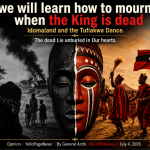
We drum and dance while the AXE of Death hover over our Tufiakwa state of Mind, Now who is next after the party.
Opinion | YelloPageNews | By General Archi, #SonOfAbakwu | July 4, 2026
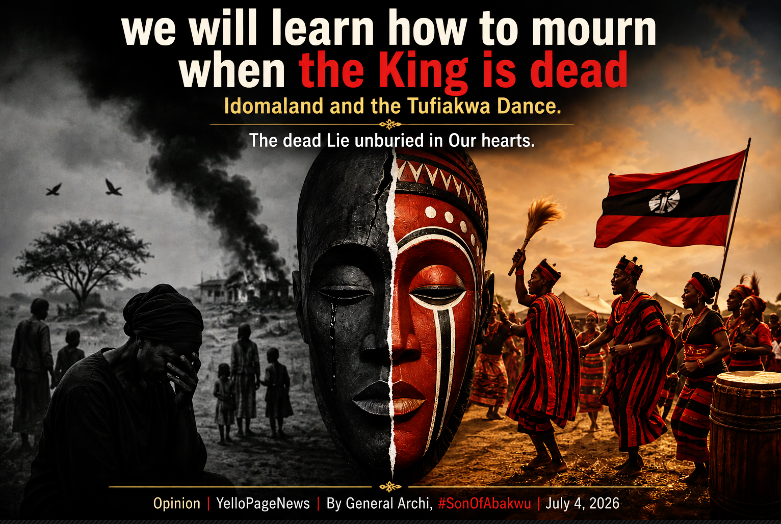
There is a kind of dying that does not happen at the moment of the gunshot. It happens later — slowly, in the silence of a people who choose not to speak, who gather in red and black not to protest but to perform, not to demand but to dance. It is the dying of the communal soul. And this week, I watched it happen in real time.
On June 26, 2026, Ardo Muhammad, the Chairman of the Miyetti Allah Cattle Breeders Association, Benue State chapter, and his associate Yakubu Isah were ambushed and killed by unidentified gunmen in Otukpo Local Government Area, shortly after returning from a police-convened peace meeting. The reaction was immediate and national. The Sultan of Sokoto expressed profound grief, demanded a comprehensive, transparent, and impartial investigation, and described Risku as “a fearless advocate of peace and unity.” Governor Hyacinth Alia condemned the killing, directed security agencies to immediately launch a thorough investigation, and ordered the strengthening of security measures. A Senior Advocate of Nigeria, Professor Sebastine Hon, wrote directly to President Tinubu, alerting him to the threat of reprisal attacks and urging swift, transparent action. The whole country paused. The whole country noticed.
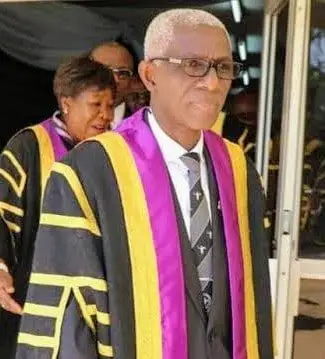
Then, one week later -on July 2, 2026 -Prof. David Salifu, former Secretary to the Benue State Government, a Professor of Public Administration and former Dean of the Faculty of Social Sciences at the Federal University Wukari, was ambushed along the Wukari-Joota Road while travelling to attend his uncle’s burial. The attackers shot him at close range in the stomach, abandoned him in a pool of blood, and he died around midnight at the Federal Medical Centre, Makurdi.
And what did the Idoma people do?
They went to Abuja to celebrate Idoma Day.
Two Deaths. Two Worlds of Reaction.
Let us hold these two facts side by side without flinching, because the contrast is the story.
When Ardo Risku was killed, the Ochetoha K’Idoma Forum Worldwide issued a statement condemning the murder, describing it as a tragic act that must not go unpunished, and urging security agencies to identify, arrest, and prosecute the perpetrators. The Idoma people themselves — out of genuine decency and communal conscience — rushed to dissociate their nation from the killing of a man who was not even their own. Zone C local government chairmen held press conferences. The chairman of Agatu LGA condemned the killing and said, “We condole with the entire family and the Fulani community worldwide over this killing.”
Good. Decency is decency. The Idoma response to the death of Ardo was the response of a people who understand that all life is sacred.
But here is the question that must be asked without diplomatic cushioning: Where is that same energy for Prof. David Onu Salifu?
Where is the press conference? Where is the statement from the apex Idoma socio-cultural organisations? Where is the demand for justice from the political class of Benue South? Where is the rage? And most painfully — where is the postponement of Idoma Day?
The Centenary, the Gathering, and the Silence
The Idoma Community UK announced August 8, 2026 as the date for the next Idoma Day celebration in the United Kingdom, calling on Idoma sons and daughters across Europe to gather in unity and celebrate their shared cultural heritage — an event described as aligned with the Idoma Centenary Plus Celebrations 2026, commemorating 103 years since the establishment of the Idoma Division in 1923.
One hundred and three years of Idoma existence. And in the very week we are supposed to be celebrating what we are, who we are, and where we have come from, one of our finest sons — a professor, a former SSG, an elder statesman of Benue South — was shot on a Nigerian road, bled out in a car driven by his frightened driver, and died alone in a hospital bed.
And we put on our red and black and went to the hall.
This is what I call our Tufiakwa state of mind.
What Collective Mourning Does — and What Its Absence Does
This is not sentiment. This is science. This is sociology. This is what we know about how peoples survive their most difficult moments.
When a community mourns together, shared grief facilitates bonding among individuals, fostering a sense of belonging and collective identity. However, the failure to mourn can lead to unresolved grief and long-term psychological consequences, such as increased anxiety, depression, and PTSD within the community.
Collective grief refers to the shared emotional response experienced by a group following a significant loss that affects many people at once. Shared mourning helps communities support one another and begin healing together.
A community that knows how to grieve together is arguably more resilient. It possesses a built-in mechanism for processing trauma, maintaining empathy, and regenerating social capital. When individuals feel supported during their darkest times, they are more likely to remain engaged and contributing members of the group.
What does the reverse of that look like? When a community does not grieve together, when it actively, visibly, publicly chooses celebration over solidarity in the immediate shadow of a high-profile killing – it sends a message. Not just to outsiders. To itself. To its young people watching. To its enemies listening. To its political oppressors taking notes.
The message is: our dead do not matter enough to pause our parties.
And the world will remember that message longer than it will remember the party.
The Contrast Nobody Wants to Admit
The Sultan of Sokoto’s swift condemnation of the killing of Ardo Risku triggered pointed questions among victims of decades of mass killings across the Middle Belt. To many, the timing and tone raised a hard question: whose grief counts?
That question has an Idoma dimension that we must be honest enough to examine ourselves.
The Fulani mourned Ardo loudly, institutionally, and with political consequence. The Sultan spoke. MACBAN spoke. A Senior Advocate wrote to the president. Ten suspects were arrested almost immediately. The federal government was put on notice. The national conversation shifted. Reprisal threats — however dangerous and wrong — at least demonstrated that someone’s death had weight.
Compare that to the reaction to Prof. Salifu’s murder. As of the time of multiple reports on July 3, 2026, the Benue State Police Public Relations Officer did not answer calls, and authorities had yet to issue an official statement on the attack. No SAN has written to the president about it. No traditional ruler has issued a statement demanding justice. And the Idoma community in Abuja was in a hall somewhere, celebrating.
This is not an argument against Idoma Day. Cultural identity matters. Celebration matters. The Och’Idoma himself, in his New Year broadcast, honoured the memory of Idoma sons and daughters who passed on, describing their lives as meaningful contributions to the collective journey of the nation, and said: “Your pain is known, your tears are seen.”
But your tears are only truly seen when you first sit with them. When you pause. When you say to the world — and to yourself — that this death matters enough for us to stop.
A People Who Have Forgotten How to Demand
The deeper crisis the Idoma Day drama reveals is not insensitivity. It is a crisis of political and communal consciousness that has been years in the making.
We have watched herdsmen attack community after community in Benue South. We have buried farmers, teachers, local government workers, and traditional rulers. Fulani militia have killed traditional monarchs, their wives, their children, in overnight raids across Agatu and surrounding areas. We have attended too many funerals. And somewhere along the line – in the fatigue, in the exhaustion, in the political helplessness -we stopped treating each death as a political event that demands political response, and started treating it as simply another tragedy to be absorbed and forgotten.
This is the rat race our writer speaks of. Not a rat race toward progress, but a rat race toward the next gathering, the next event, the next occasion to feel normal -while the land burns around us and our best people die on the roads.
Not everyone relates to loss the same way, and that can lead to tension about how to grieve appropriately. But there is a difference between processing grief differently and not processing it at all. There is a difference between moving through tragedy and running from it.
When a people lose a distinguished professor, a former SSG, an elder statesman -a man who served with distinction as Secretary to the Government of Benue State, shaped the lives of countless students through decades of teaching and mentorship, and whose scholarship on governance, public policy, rural development, peacebuilding, and conflict management enriched national discourse — and the community’s response is to put on the red and black and dance… something has broken. Something deep.
Solidarity Is Not Silence. Postponement Would Have Been Power.
The simple postponement of Idoma Day, even by two weeks -would have been a statement. It would have said: we see our dead. We honour them before we honour ourselves. It would have been covered by every newspaper in Nigeria. It would have forced the political class of Benue South to take notice. It would have given the Idoma people a moment of genuine collective mourning that, as community bereavement traditions show, reaffirms connection and mutual reliance, and strengthens the social bonds that make a people resilient in crisis.
Instead, we chose performance over protest. We chose the hall over the street. We chose red and black dancing over red and black mourning.
Security meetings, as this writer rightly observes, are not discussed in the open. But public grief is not a security meeting. Public grief is a political act. It is how peoples communicate to power that they count, that they notice, that they will not be silenced, that they refuse to disappear quietly.
The Fulani know this. They have always known this. When one of theirs falls, the full weight of their institutional structures, religious, traditional, political -comes to bear. There is no dancing in the week that a leader dies.
What do the Idoma do? We gather to celebrate. And we wonder why nobody takes our losses seriously.
The Final Word
The disregard being expressed here is not for the dead. Prof. David Onu Salifu has gone beyond where our parties can reach him. The disregard is for the living -for every Idoma person who must navigate those roads, who must face those gunmen, who must survive in communities where the state offers no protection and the community offers no solidarity.
When we celebrate in the shadow of our fallen, we tell the surviving Idoma that their lives are background noise. We tell the gunmen and the bandits that the roads they control can produce a body on Thursday and a party on Saturday without consequence.
We tell ourselves, and here is the deepest wound -that we are a people without the discipline to pause, to demand, to insist that our dead matter.
A people that cannot mourn cannot fight. A people that cannot pause cannot protest. A people that dances while its scholars bleed on the roads is a people that has quietly accepted the terms of its own diminishment.
That is the Tufiakwa state of mind.
And until we cure it, no Idoma Day, no matter how well attended, no matter how colourful the aso-ebi -will move us one inch closer to justice.
The author writes as a Son of Abakwu and opinion contributor to YelloPageNews. Views expressed are personal and do not necessarily represent the editorial position of the platform.